VERIQA: Clinical Experiences Part 2
Two years ago, five months after the introduction of VERIQA, we presented our initial clinical results. What has happened since then?
Software Updates
On Nov 5, 2025 we upgraded from version 2.1.20 to version 3.0.36. This upgrade was performed remotely by PTW. From this point on, all new plans were automatically sent to version 3.0. Older evaluations are still accessible on a different port on the VERIQA server. They can be viewed but not recalculated.
In June 2026, version 3.1.18 was offered for download via the myPTW website (21GB). The update, intended for self-install by the user, was performed on Aug 18, 2026. It was a simple install without the need for external support. Version 3.1.18 is the current version.
Statistics
Each new VERIQA analysis increments the Monte Carlo counter by 1. It is therefore straightforward to determine the total number of evaluations performed over a given period.
A total of 3606 evaluations were conducted using version 2.1. As of Nov. 5, 2026, the counter stands at 1751. This brings the cumulative total of 5357 VERIQA plan evaluations performed to date.
Taking the observation period as beginning on June 11, 2024 (the day of the first calculation), the daily average has been 8.5 evaluations per working day1.
Updated Evaluation Criteria
Regarding evaluation criteria, we simplified things in the following way: we now use GAM32 for everything. This removes the need to define "Conditions of Application" entirely.
While other tasks can still be applied manually by re-running an evaluation, the Gam32_1% (5% dose) task is the default (last row):
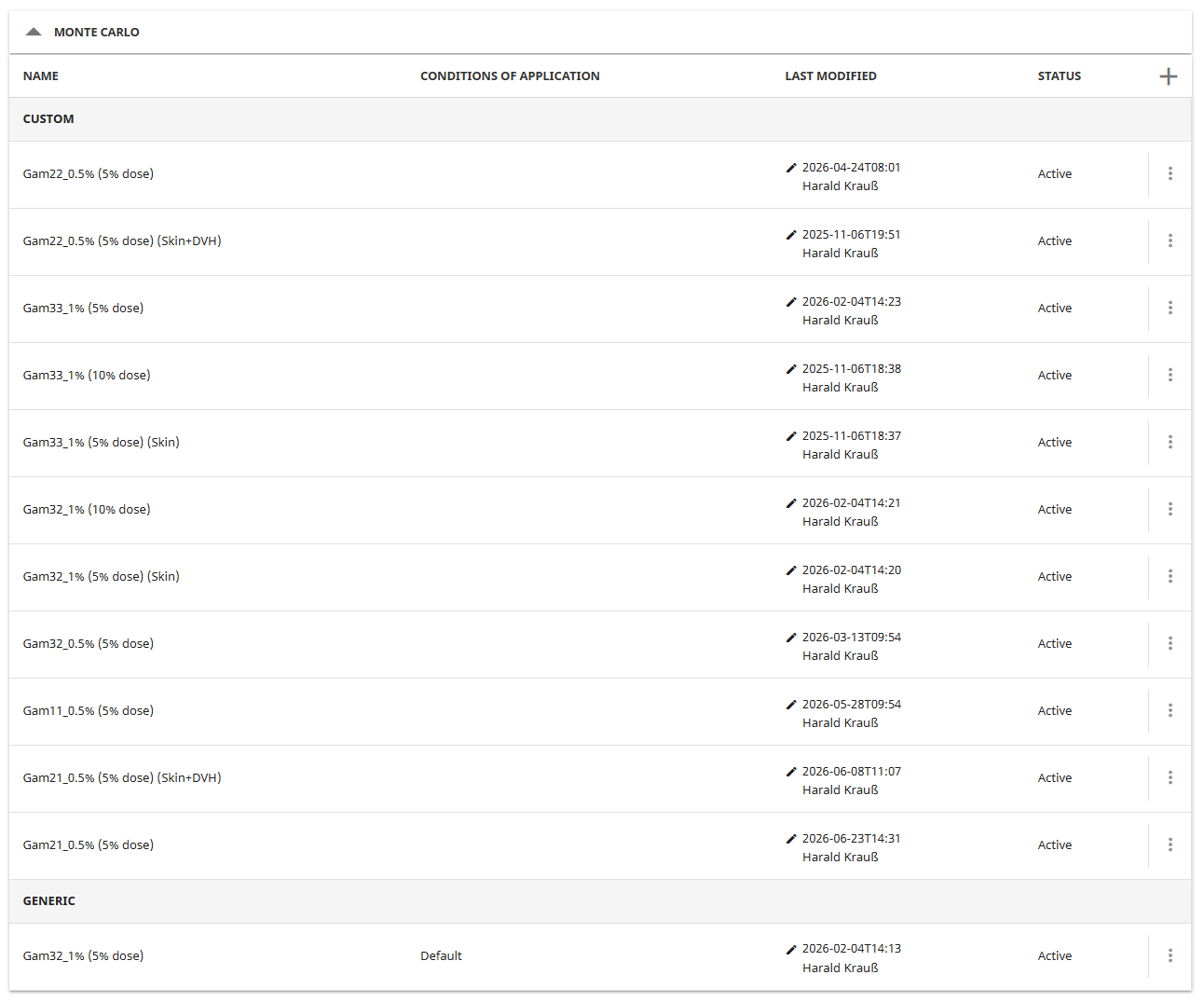
(Our task list in version 3.1 is very simple. No conditions of application are needed.)
What does this mean? In order to pass the test, 95% of all BODY voxels must be within 3% of max referenced dose and a Distance to Agreement (DTA) of 2 mm. The Monte Carlo Dose engine precision is set to 1%, dose cutoff is 5%.
Sometimes (e.g., when treating a knee), a large fraction of the BODY structure is filled with foam or air:
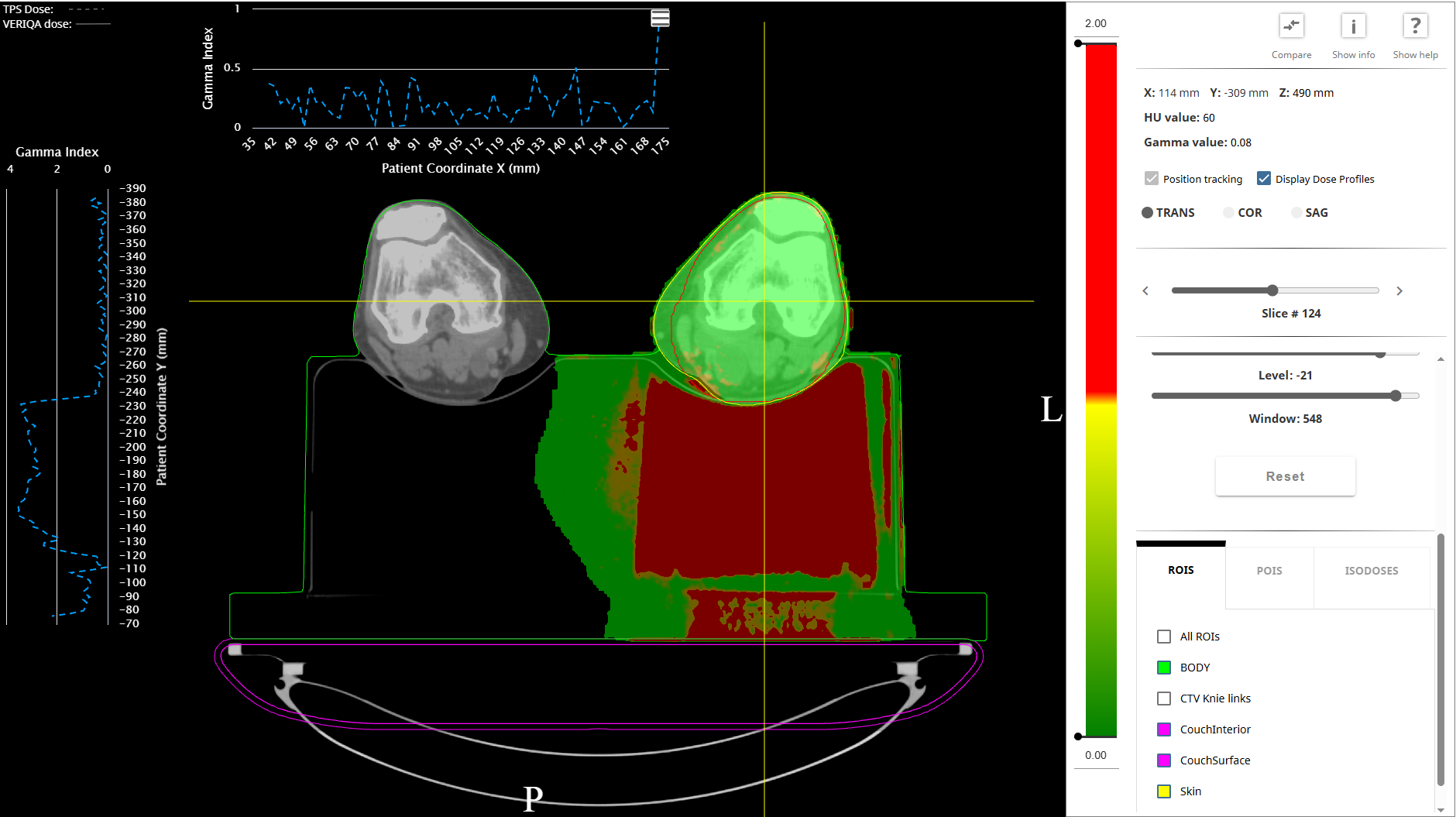
(Knee example. Evaluating Skin (yellow) instead of BODY increased GAM32 from 70.74% to 99.91%)
In such a case2, the Skin structure is evaluated instead of the BODY3. This gives more clinically relevant results.
Evaluation Results
We looked at the last year (Nov. 3, 2025 until Oct. 30, 2026) and evaluated, for all applied tasks, the number of VERIQA evaluations, the average pass rate and the minimum pass rate.
- GAM32: total 982 evaluations, average pass rate: 99.79%, minimum pass rate: 96.65%
- GAM22: total 298 evaluations, average pass rate: 99.70%, minimum pass rate: 96.44%
- GAM21: total 021 evaluations, average pass rate: 99.83%, minimum pass rate: 98.27%
If we look at the cases with the minimum pass rates, we find the well-known patterns. The two main reasons for reduced pass rates are:
- Tail discrepancy
- Structures outside the BODY
We give an example for both.
Tail Discrepancy
We already described extensively the problem that AXB slightly underestimates dose in the tails ("tail discrepancy"), and also offered a solution. In order to see the effect in clinical plans whenever it occurs, we use a 5% dose cutoff instead of the recommended 10%. Blending out the effect by increasing the cutoff doesn't remove the discrepancy.
The offered solution (replanning with rotated collimator) is not always possible. In such a situation, at least we want to see the deviation.
From the 982 GAM32 evaluations, the lowest pass rate (96.65%) occurred in a left breast plan with four fields (two static with 10X, two IMRT with 15X). We switch to COR view because the discrepancy occurs outside the irradiated volume, on the cranial side. The green line in the images is the 50% isodose. The red line is the PTV.
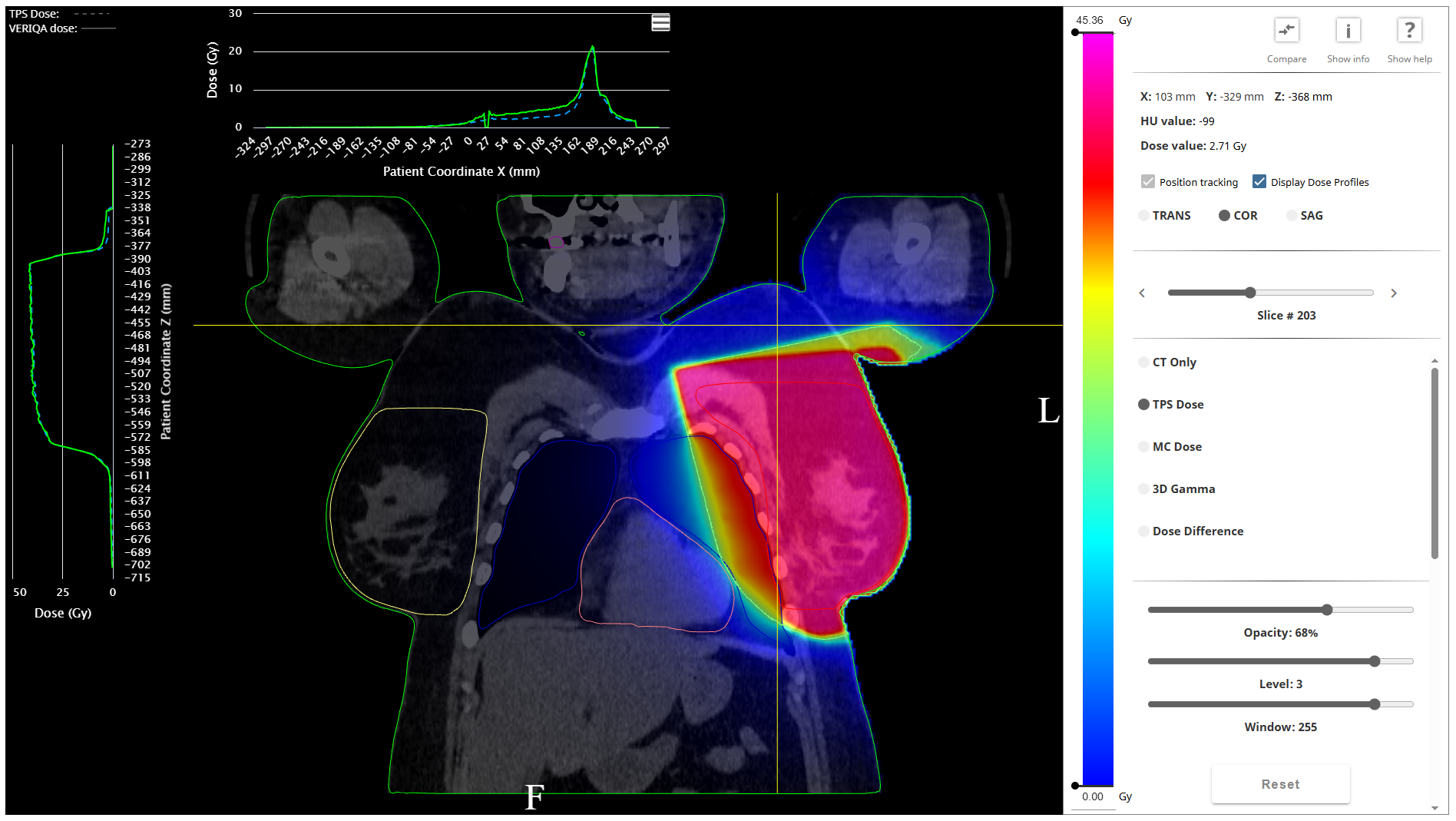
(Eclipse dose. The dose profiles correlate with the cross hairs.)
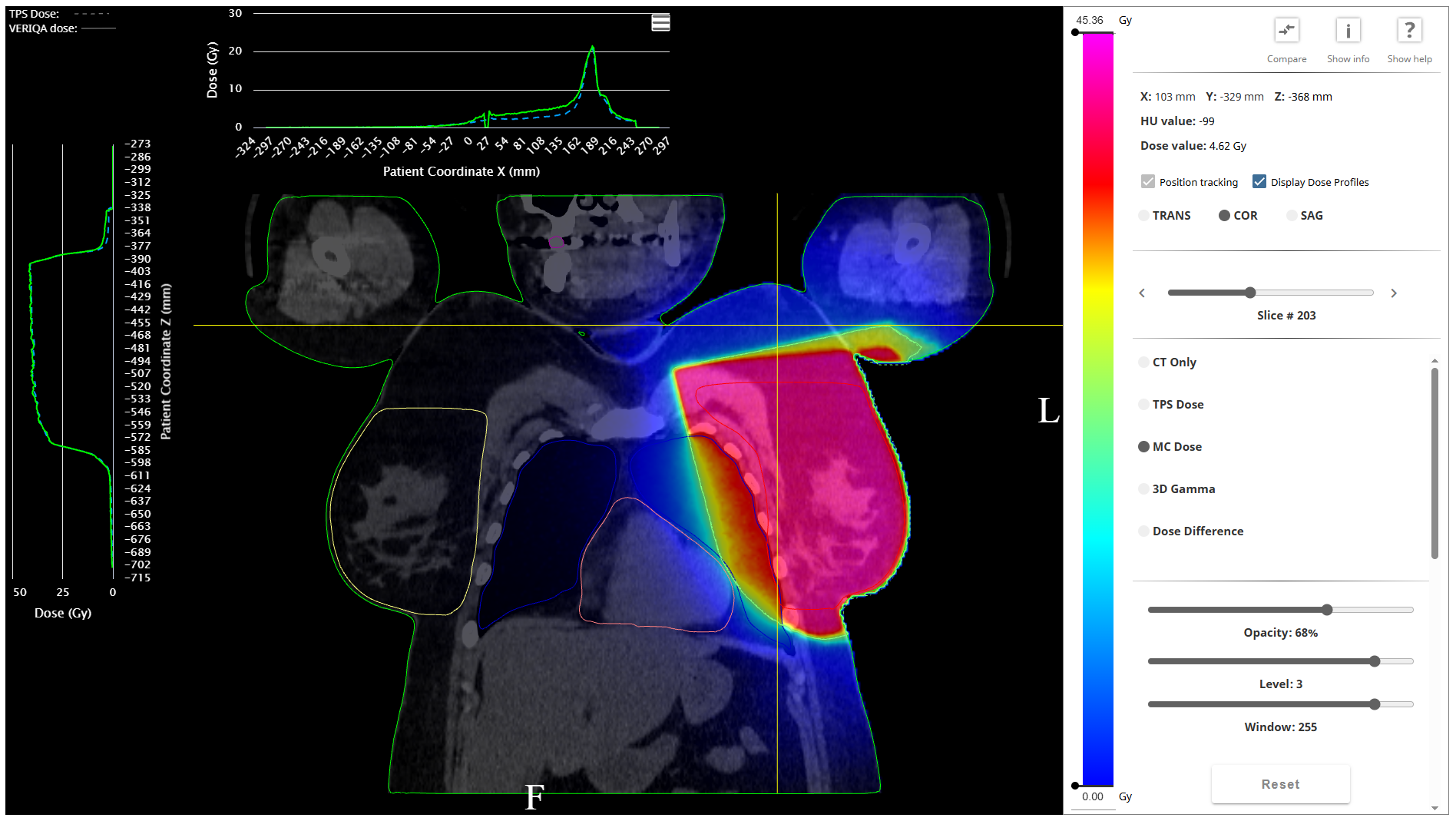
(MC dose. Dose profiles are identical to the previous image: They always show both TPS dose and MC dose.)
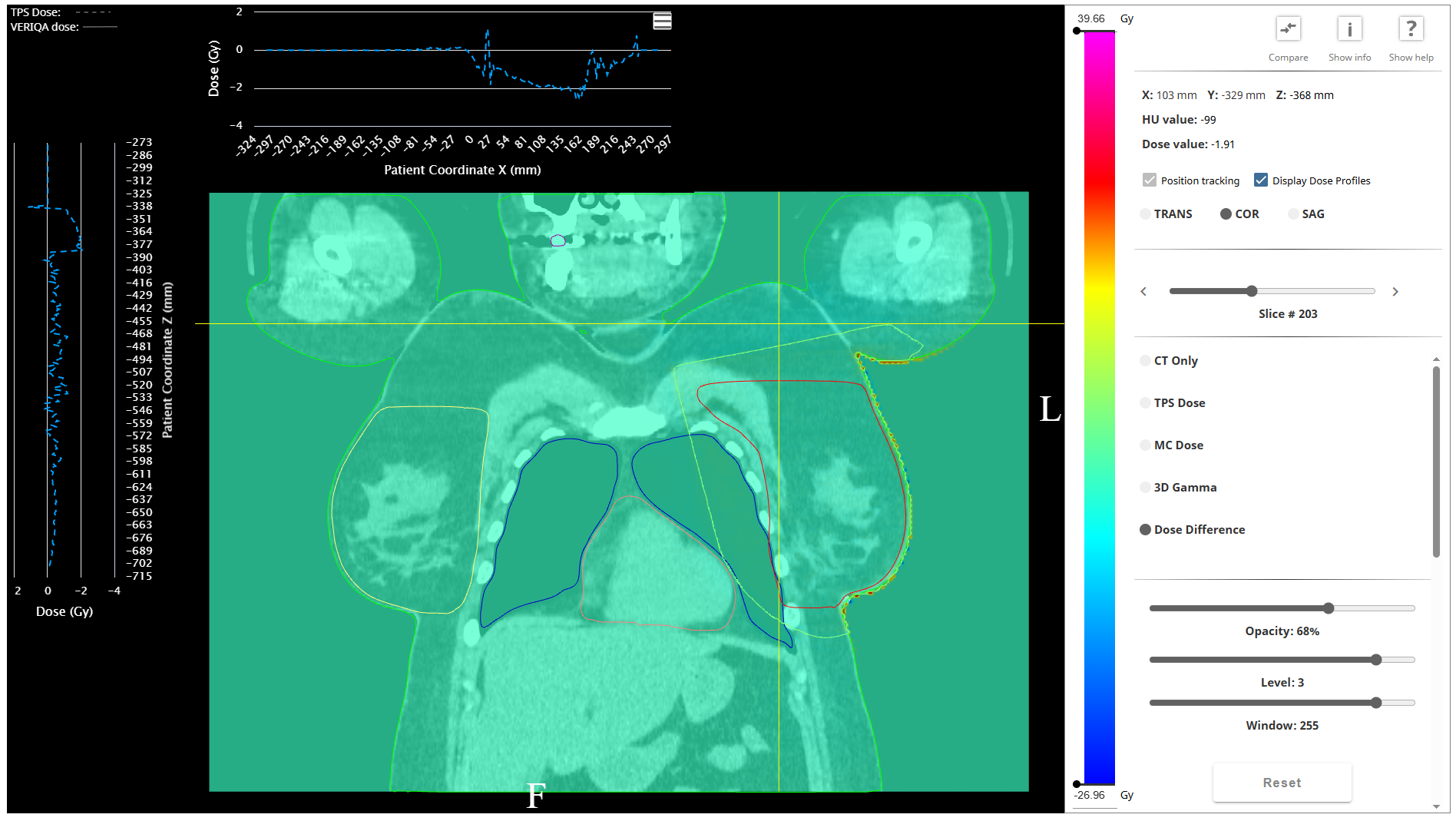
(Dose difference.)
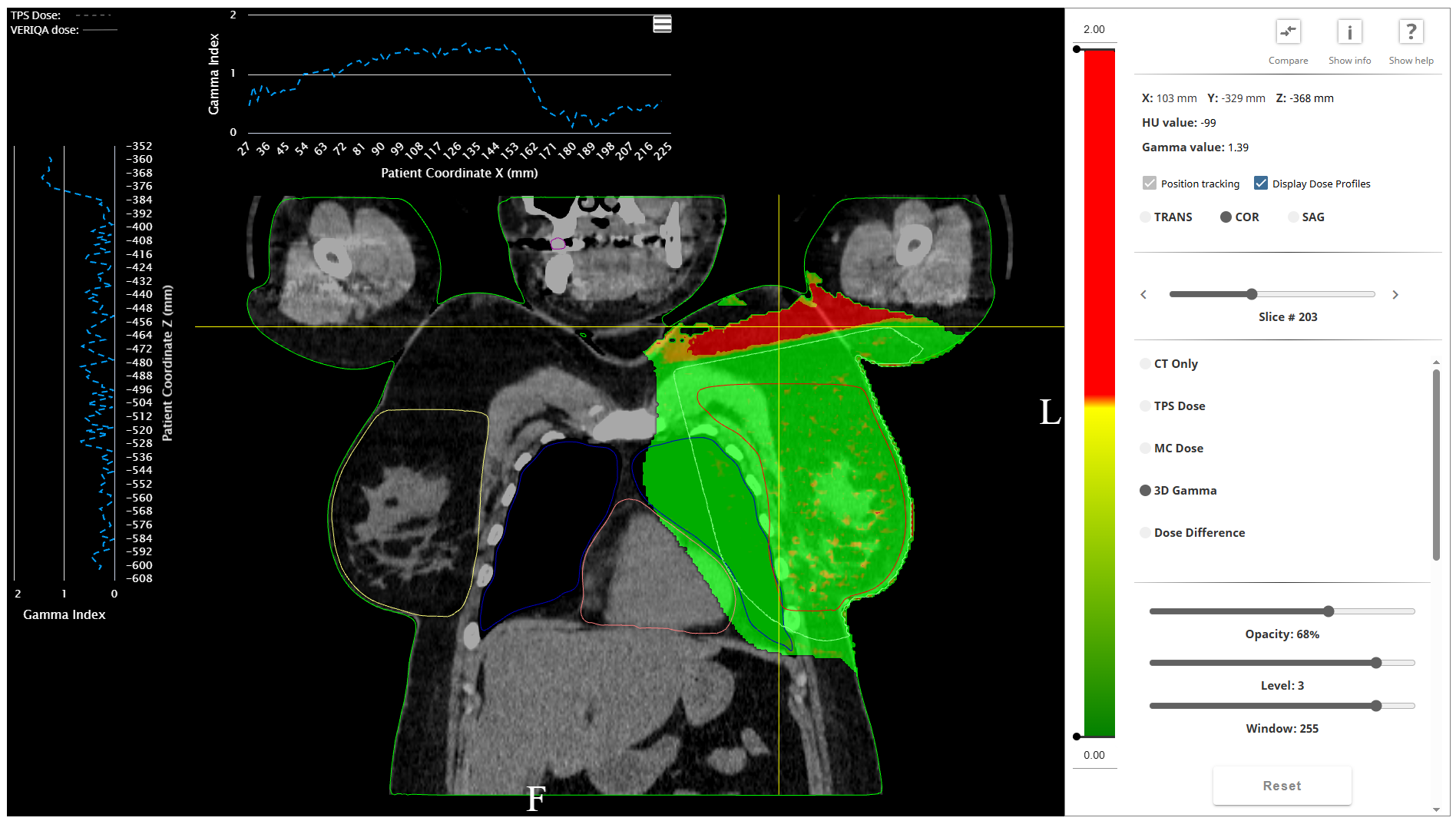
(Gamma map. Red voxels due to tail discrepancy are between 5% and 10% dose.)
If we reevaluate the plan with 10% cutoff instead of 5%, the discrepancy disappears and the pass rate increases by 2.8%, from 96.65% to 99.43%:
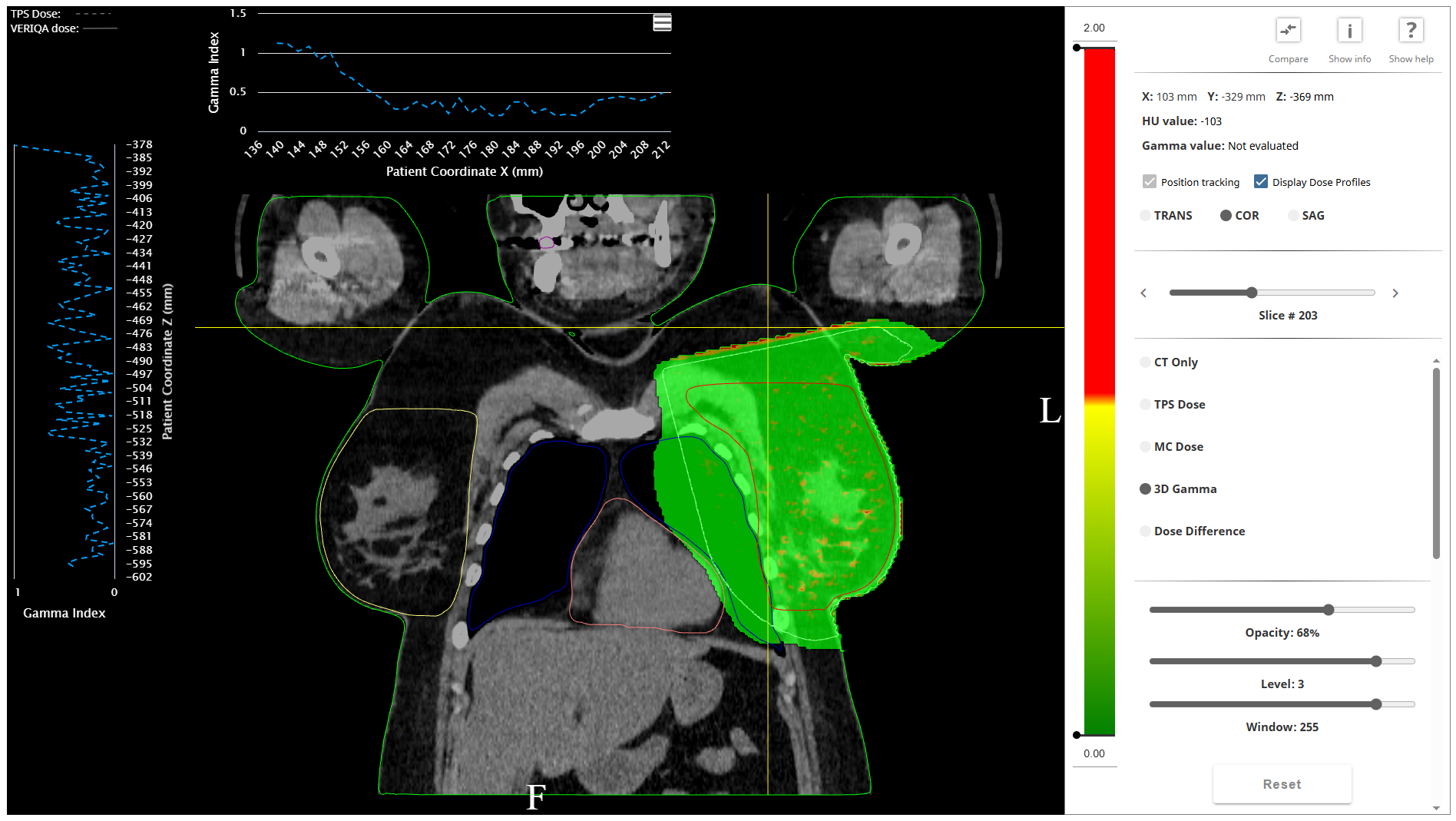
(Evaluation with 10% cutoff hides the tail discrepancy.)
Structures Outside of BODY
In breast plans, our PTV structures sometimes extend outside the BODY. They have no function during dose optimization or DVH calculation (all relevant plan PTVs are cropped). They are rather intermediate stages during PTV generation which are kept in the structure set and could as well be deleted.
Since Eclipse and SciMoCa treat such structures differently (SciMoCa calculates dose while Eclipse does not), keeping them can decrease the pass rate. The effect is much smaller than the tail discrepancy effect, by a factor of 10.
The following plan has an initial GAM32 pass rate of 99.65%. It is a left breast hybrid IMRT plan. As above, we show TPS dose, MC dose, dose difference and Gamma map:
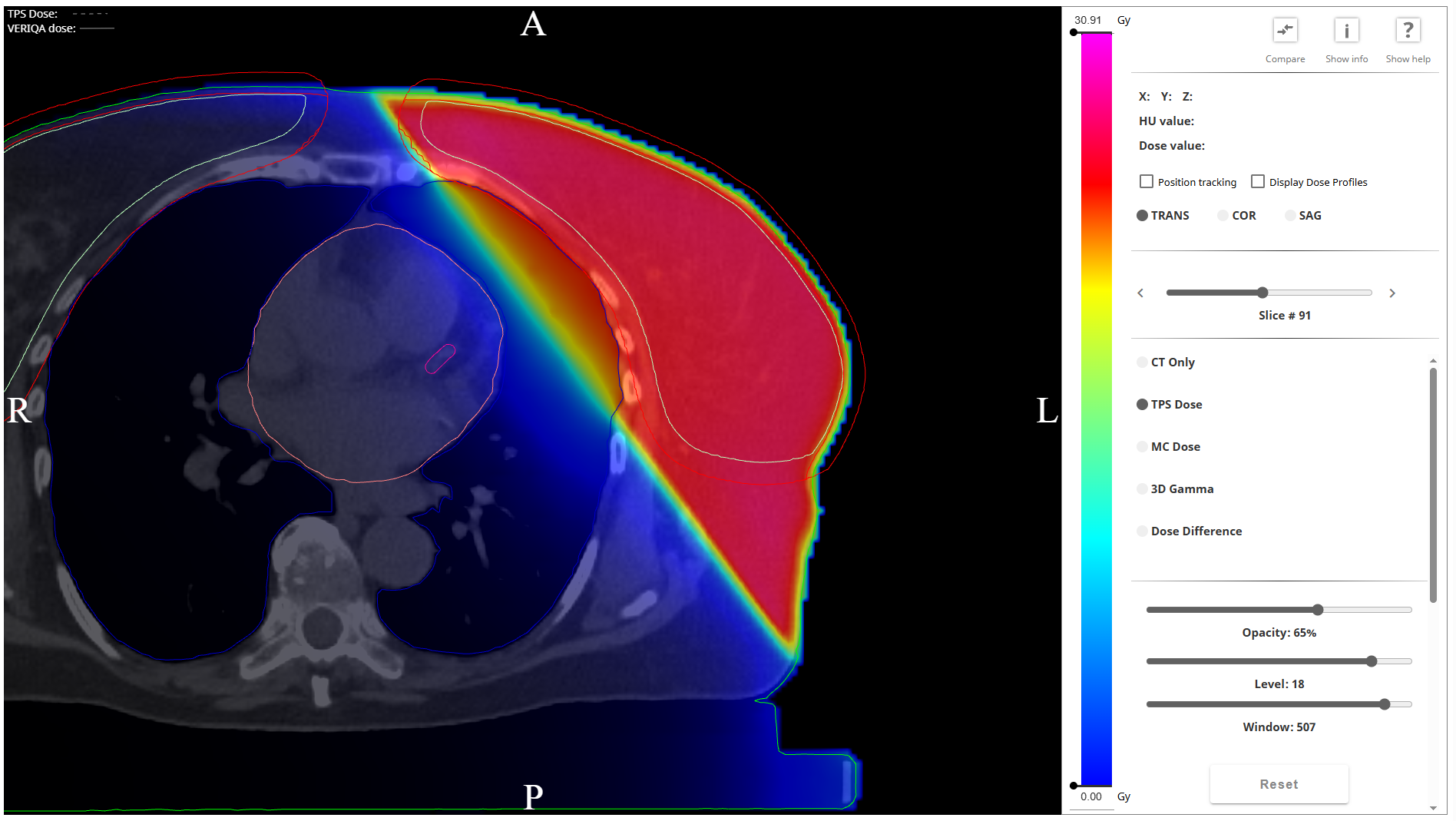
(GAM32 = 99.65%: Eclipse dose. No calculation beyond the BODY.)
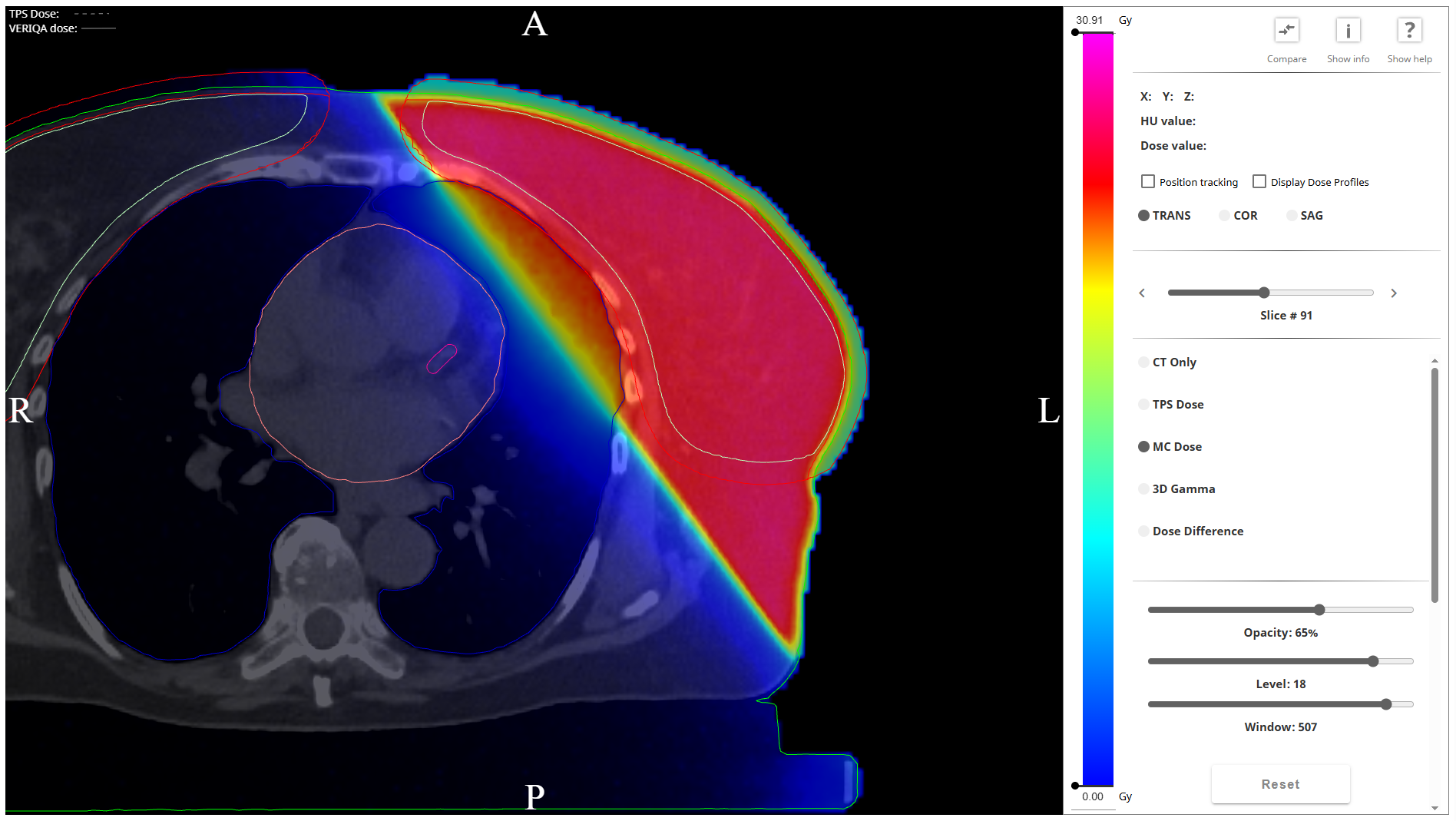
(GAM32 = 99.65%: MC dose. PTV extends outside BODY, SciMoCa calculates dose in these voxels.)
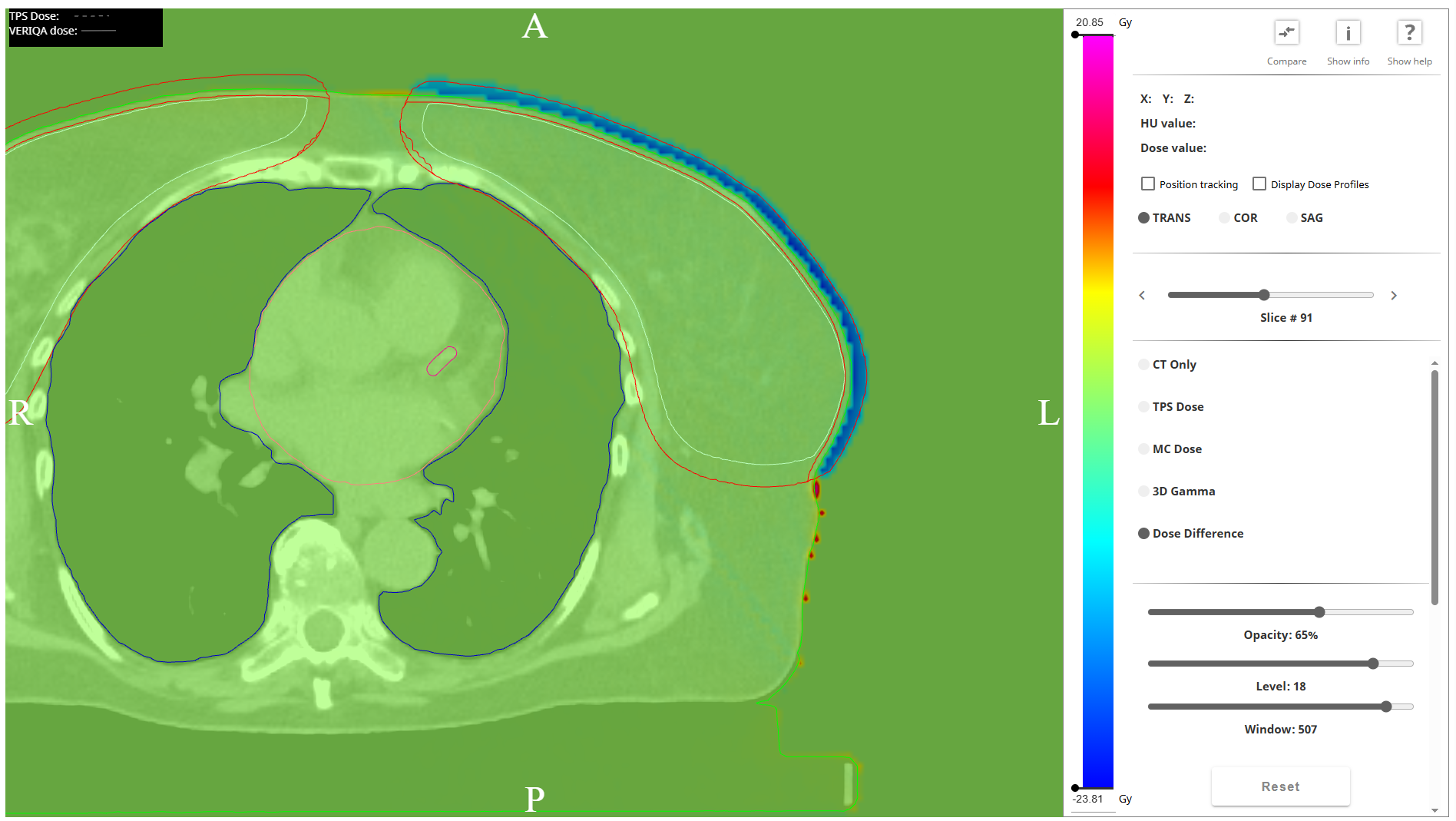
(GAM32 = 99.65%: resulting dose difference.)
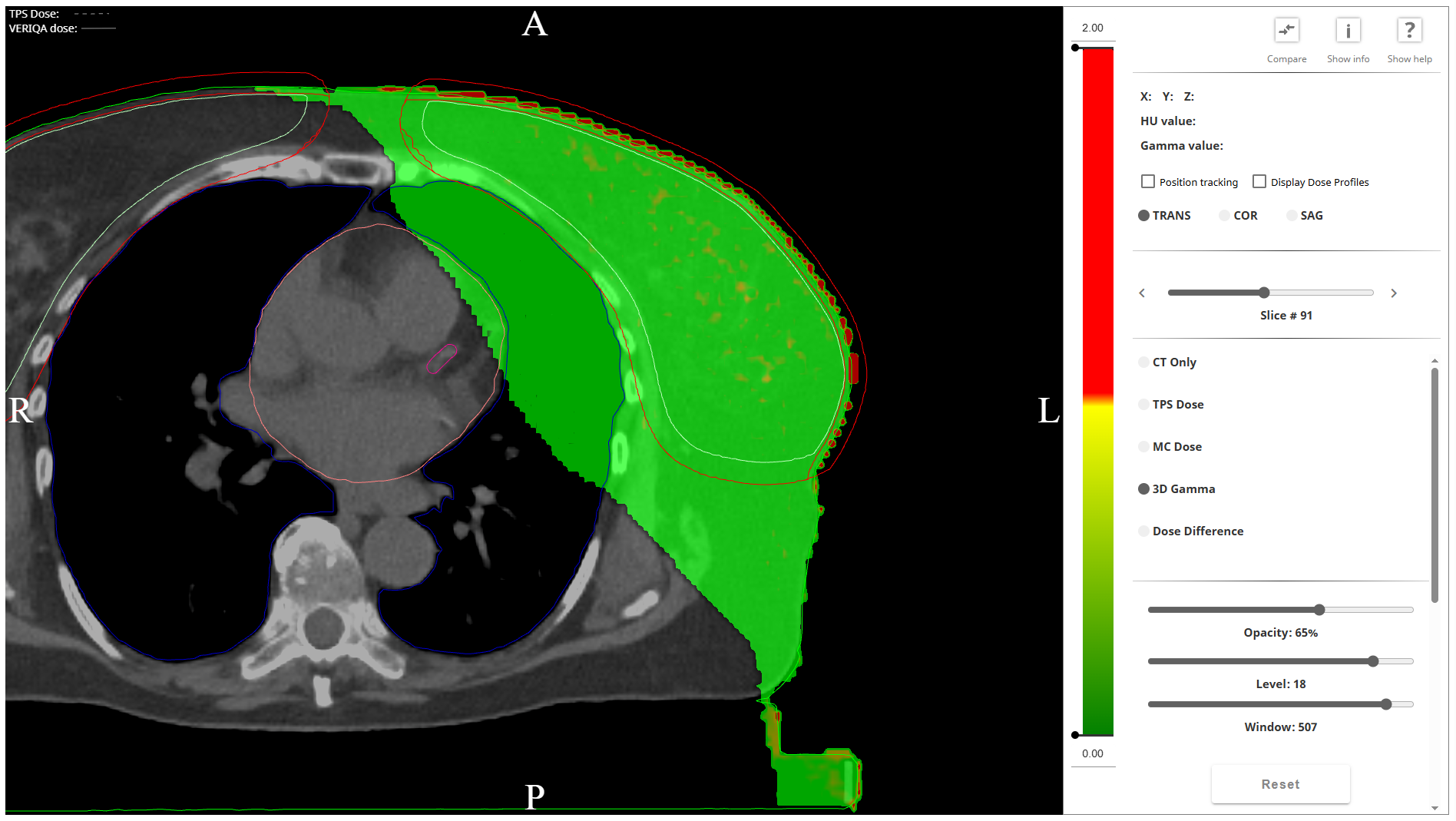
(GAM32 = 99.65%: Gamma map. Some red voxels in surface zone reduce pass rate.)
We already mentioned that Eclipse and SciMoCa use different rules for calculating dose outside the BODY. Gamma pass rate is only sampled inside the BODY, because our Gamma protocols tell VERIQA to do so (ROI = BODY). However, the extension acts as a bolus in the SciMoCa calculation. Although this "bolus" is filled with air, it has some small effect on the surface voxels, increasing dose.
It is simple to solve the issue, by deleting the unnecessary structures. We go back to Eclipse, duplicate the structure set, remove all structures that extend outside the BODY, and send the plan to VERIQA again.
With the modified structure set, the Gamma pass rate goes up by 0.3%, from 99.65% to 99.93%:
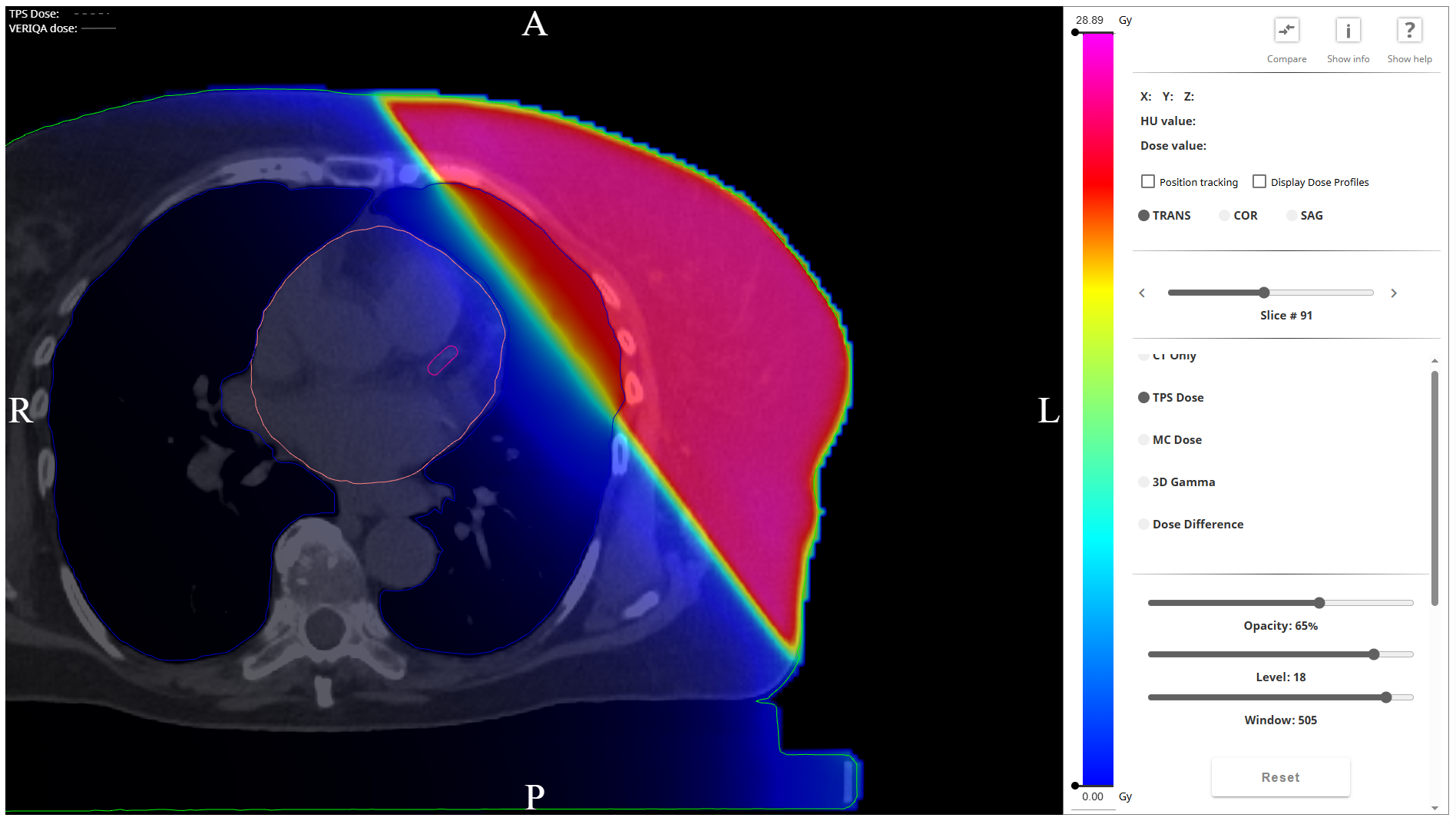
(GAM32 = 99.93%: Eclipse dose is not affected, because the changes were outside the BODY.)
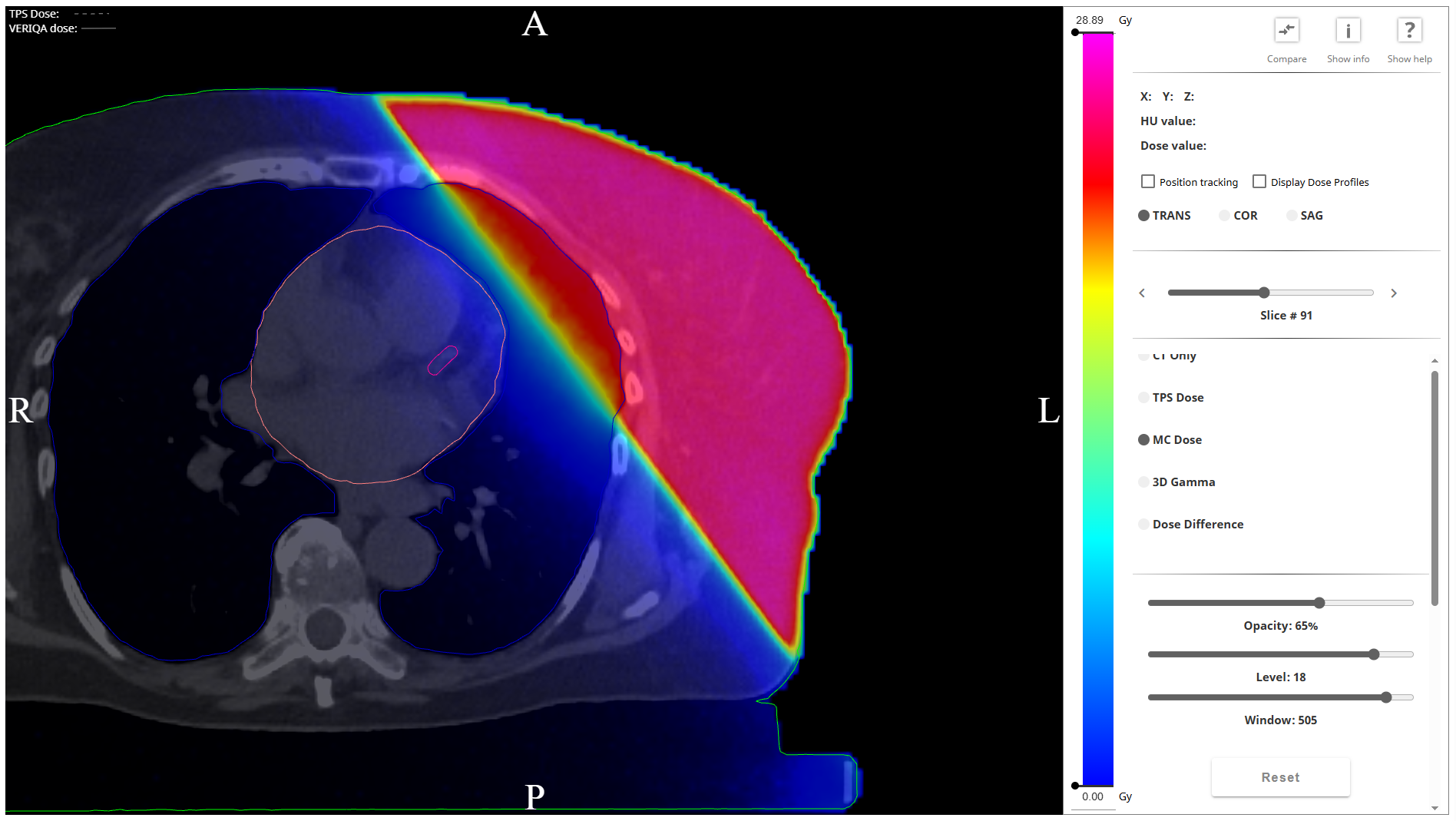
(GAM32 = 99.93%: MC dose. SciMoCa calculates inside the BODY.)
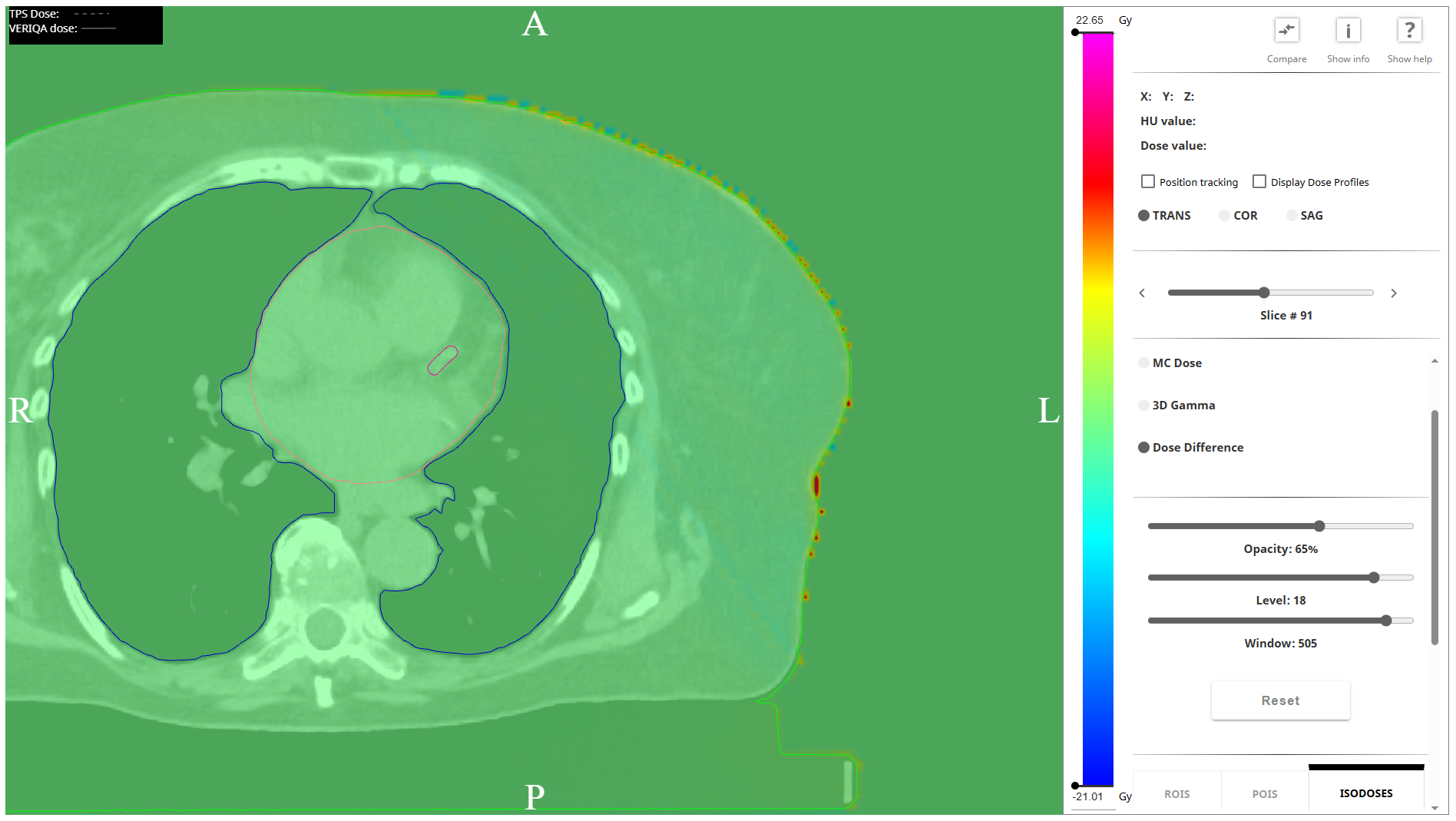
(GAM32 = 99.93%: resulting dose difference in the surface zone is small.)
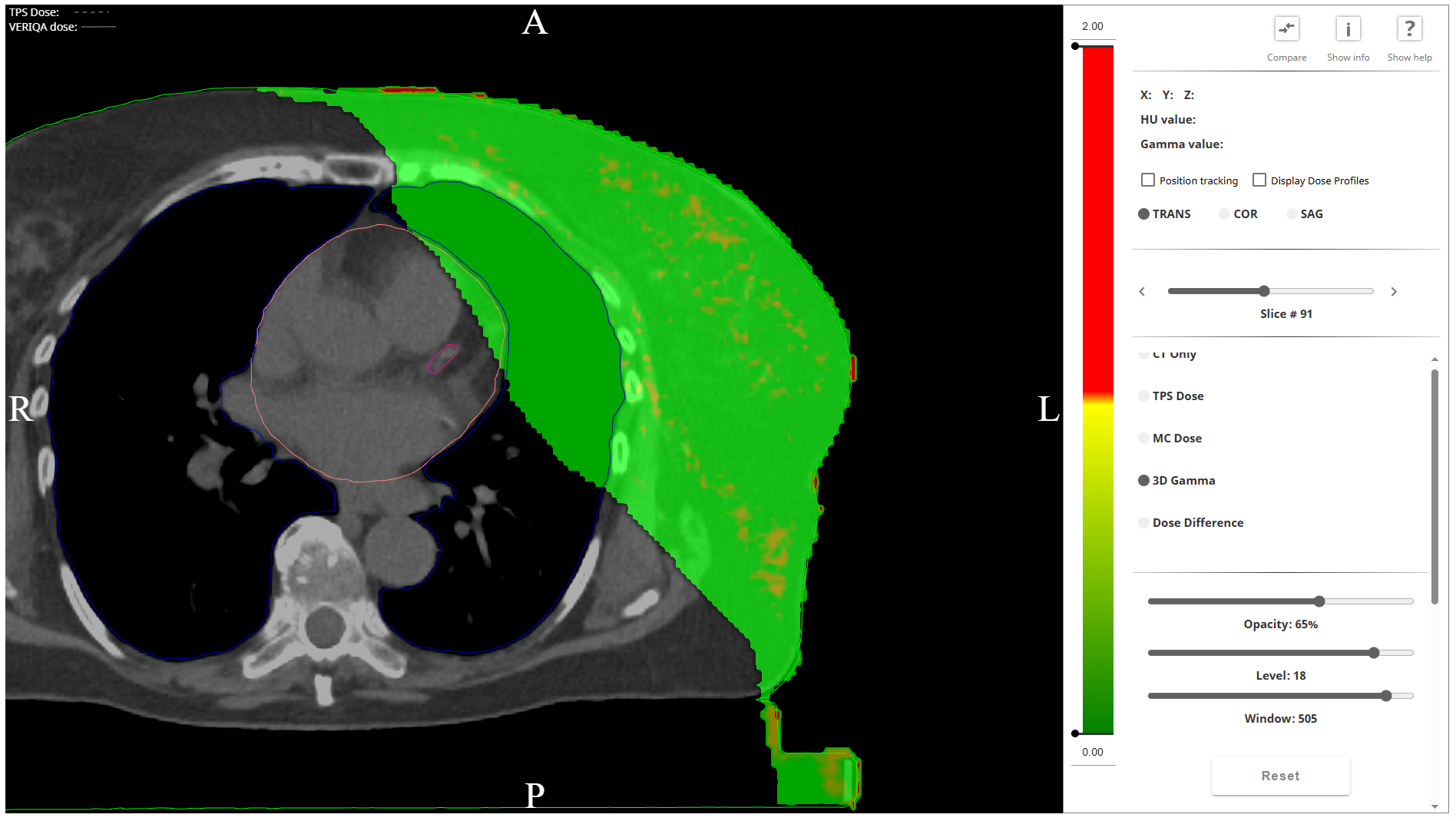
(GAM32 = 99.93%: Gamma map. Significantly less red voxels in surface zone result in higher pass rate.)
We understand the interrelationships and can explain the deviations. This is also the reason why we settled on the GAM32 test for all cases, from simple opposing fields, over IMRT and VMAT, to HyperArc: the results are always on the safe side. So far, we only saw "green flags" in the test results.
Patient Position Issues
We once had a Dose Engine Error we could not explain. VERIQA simply refused to calculate. We suspected that it had to do with the Patient Position, which is usually Head First Supine (HFS) or Feet First Supine (FFS). For the actual patient, it was Feet First Decubitus Left (FFDL), because an ankle should be treated and the patient was positioned on his left side on the table, feet towards the Gantry.
Copying the plan to a HFS phantom and sending this to VERIQA calculated without issues. It was later confirmed by PTW that in 3.0 (and older versions), only HFS, HFP, FFS, and FFP are supported, but not FFDL or FFDR.
Documentation Issues
To document the plan QA results in our own system, we use the Plan Evaluation Report from VERIQA. We also need a printout with the results which we can attach to the (printed and signed) Eclipse treatment plan.
In version 2.1, the whole report would fit on a single sheet of paper. In version 3.0, PTW has blown up this report to 8 pages (non customizable).
We found the following solution: we print only pages 1 and 3 because they contain the information that is relevant to us. When printed double-sided, this produces the desired single sheet. In our iCheck database however, the full 8-page report is attached to the VERIQA plan check:
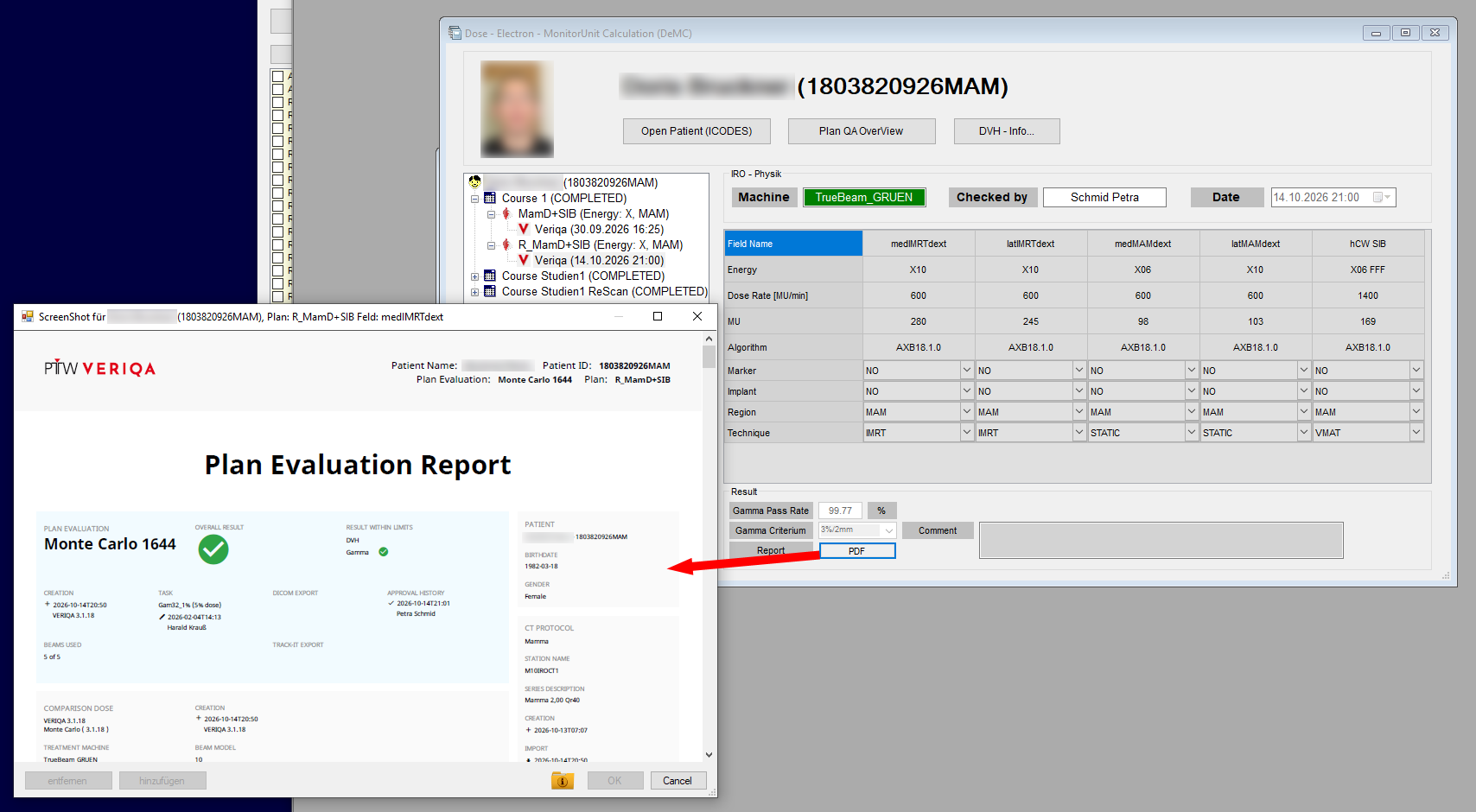
(iCheckNet with patient QA results attached to the clinical plans.)
Conclusions
Since its introduction at our department, VERIQA proved to be an extremely valuable patient QA tool. Whereas Portal Dosimetry gives a field-by-field fluence verification (in other words: evidence that the MLC performed correctly), MC calculation is in full 3D.
Calculation performance and server stability are also excellent: while version 2.1 could occasionally (maybe 3 or 4 times in the total period) issue a Dose Engine Error which could be solved by choosing a different calculation grid, this never happened since version 3.0. Also the server reboots described previously weren't necessary after upgrading to version 3.0.
Notes
1 We used the Excel function NETWORKDAYS() to exclude weekends etc.
2 Although the agreement between Acuros XB and SciMoCa Monte Carlo is generally very good, dose deviations in very low density areas can be larger than 3%.
3 One could argue that the Skin structure (representing the patient) is always more relevant than the BODY (representing - in our institution - patient plus immobilisation). This is true. However, we do not create the Skin structure for every patient. (Not yet.)